I regret to announce that this blog is currently under sedation in the intensive care unit for treatment of inactivititis. Recovery is expected to take a while. In the meantime, a Loyal Commission of Inquiry will be established to determine how this blog deteriorated to its current moribund state. A full and impartial investigation will be launched, leaving no stone unturned. I hope the same will happen with the investigation into the late Teoh Beng Hock's death. It's sad to see that one critical thing that the government needs now is what it lacks: credibility.
On another note, I was in Tioman three weeks ago, and I saw more impressive sea creatures while snorkelling than while diving*. I was pleasantly surprised that the house reef just off the beach at the southern end of Salang bay hosted bumphead parrotfish, a moray eel and some razorfish, which are creatures we normally see only when diving at less accessible sites. There was a turtle too, but I was most pleased to see the small school of five bumphead parrotfish, each about one metre long. They hung around the reef in usually in the late afternoon and allowed us close encounters. We went snorkelling on Monday afternoon, Tuesday afternoon and Wednesday morning, and all three times we saw the bumphead parrotfish. The only other times I've ever seen bumphead parrotfish were while diving at Perhentian and Sipadan. I guess I'll have to change my impression of Tioman. I previously assumed that since Tioman was getting very developed and well-visited, the nearshore marine environment would have deteriorated and become rather lifeless. So I was proven wrong, apparently.
*[ We dived at Chebeh and Malang Rock. Chebeh had nice swim-through passages under the boulders, plus colourful sea fans and nudibranchs. I caught a glimpse of a blacktip shark at Malang Rock but the visibility was too poor for us to spot any whale sharks. :P ]
But, I must still say, the conditions on land are not very appealing. The little river flowing to the sea at Salang is filled with untreated or minimally treated wastewater from restaurant kitchens and chalet bathrooms. The river bed is mucky with an awful black colour, and there's a foul odour at certain times. It's only because of the incoming and outgoing tides flushing the river mouth that the river doesn't become more dirty. At high tide the river stops flowing and the icky water acculumates. Then at low tide, the river drains out to the sea, taking with it all the dirty water. The next high tide brings in (relatively) clear sea water. But that just means that the yucky river water is being diluted into the sea. Well, the river condition is not THAT bad (not like the Klang River), but it's certainly not befitting of a tropical marine park island. It gets worse during weekends and peak tourist seasons when more visitors result in more dinner plates washed and toilets flushed.
In the bigger picture, there's some sort of trade-off. If visitors want cheap accommodation and food, then I suppose the operators won't be able to afford the investment in proper wastewater treatment systems. But I'm not sure if the chalet operators are earning lucrative incomes or scraping by with the minimum. Some visitors would say that they are already paying so much for their spartan chalet and restaurant food on the island. Well, price is relative, but is value relative too? Would you be willing to pay more for your visit if you knew that the money is used to take care of the wastes that you generate? There's no free lunch, and no free toilet flush either.
Indah Water is planning to build a proper extended aeration activated sludge centralized sewage treatment plant at Salang and Tekek. The EIA was approved in July 2008, but I'm not sure when the project will start and be completed. Let's hope that the project will do good and not cause more damage, or become a white elephant (new species on the island). Indah Water will probably be charging the chalet and restaurant operators for sewerage fees... and I wonder if the operators will pay the fees or even connect their sewerage pipes to the treatment plant in the first place. Do you pay your Indah Water bills?
Showing posts with label scuba diving. Show all posts
Showing posts with label scuba diving. Show all posts
Thursday, July 30, 2009

Friday, April 03, 2009
Diver Identification 101
I don't know of any diving courses that teach this. I haven't seen it in any syllabus. I'm talking about diver identification underwater. How do you recognize your buddies and fellow divers while you're all underwater? You can't talk, obviously, and you can't hear very well. You can hear sounds but they're all muffled and you can't locate the direction of the sound source. One of the most dreaded sounds is the drone of a ship or the buzz of an outboard motor overhead. You don't know where it is coming from, how near it is, whether it is headed your direction, whether it's going to pass over you, whether it's going to hit you as you ascend... it's definitely not a nice feeling to be hit by a boat propeller. It's like, see you in heaven, and make sure you get there (but it's already too late to do anything about it at that time anyway).
Anyway, I was just making the point that it's really difficult to communicate by sound, and impossible to speak unless you have those funky underwater radio communication systems. It doesn't help that tank bangers and shakers sound the same. So when you hear a sound and look around, how do you recognize your buddies? It's important to know who is who so that you know where your buddies are, if anyone is lost, or just so that you can "talk" to the right person.
Thus divers rely on visual communication such as hand signs. And to identify my buddies, I look for visual cues and identification features as follows:
1. Bubbles
The #1 telltale sign of a diver is the bubbles, which can be seen from far away. This is the first step, to identify that a diver is present. Bubbles reflect light, and stand out as silvery trails rising upward against the backdrop of blue or green or whatever colour the water is. The only problem is when visibility is bad, then you have to really strain your eyes to spot the bubbles.
It's easy to spot a diver once you trace the source of bubbles. Even if there is a visual obstruction in between the other diver and you, such as a boulder or coral outcrop, you can still see the bubbles rising above the obstruction. Another thing about bubbles is that they are the only way to spot a diver from above water, unless the water is so clear that you can see to the bottom.
Bubbles tell you that a diver is there, but it's almost impossible to tell who that diver is, unless you know that diver's bubble pattern! Like I said, it's almost impossible, so to identify a diver you need more definitive clues...
2. Tank
Scuba tanks are big and usually bright yellow, or shiny aluminium. So they're really useful for spotting a diver from afar, such as in situations when I have lagged behind the group to play with a cuttlefish and I need to locate my buddies to regroup. I know, diving mantra #1 is to always dive with a buddy, but sometimes the buddy wanders away, or I linger while the buddy moves on. Ah, well. Just look for the bright, shiny tank. Sometimes the dive operator has different colour tanks, so I can identify who's who by matching the tank to the diver, but I would need to remember before the dive who is using which type of tank. For example, Diver A = yellow tank, Diver B = silver tank, Diver C = yellow tank with badly peeled off paint, Diver D = silver tank with sticker, etc. The problem is, usually the tanks are changed for each dive, so you have to recalibrate the ID before a dive. But if the tanks are all the same colour, then, too bad.
3. Fins
Fins are really useful identification clues. As there are many brands and models of fins on the market, usually each diver would have a different type. Fins are also very visible from far especially as many types of fins are brightly coloured and have distinctive patterns, except the black ones. I find this one of the most useful identifying features. I usually look for the fins first. A positive ID of the fins and wetsuit (below) is usually enough to identify who's who.
4. Wetsuit
The wetsuit is useful for identifying a diver as wetsuits come in different patterns, designs and colours. The designs on the legs and arms are the most visible, so I look out for them too while looking at the fins. Some wetsuits are full length, some are shorties. Wetsuits are visible from far as they cover most of the body of the diver. But if everyone is wearing similar wetsuits, e.g. they're all rented from the same operator, or if everyone is wearing black, then you'll have to look for other ID features. Some divers wear beanies over their head. Some wear sleeveless vests. Some divers don't wear wetsuits.
5. BC & Regulator
It's easy to identify a diver based on the buoyancy compensator (BC) a.k.a. buoyancy compensating device (BCD). BC's are visible from far, and have different designs, patterns and colours. The problem is when divers have the same model of BC, or similar looking BCs, as is often the case with rented equipment.
Another identifying feature is the regulator, but this is not so obvious because it is rather small. You could also look at the arrangement of the hoses, e.g. how the octopus is attached, the colour of the octopus hose (yellow or black?), whether the pressure gauge is clipped on or dangling below and leaving a trail of destruction as it drags over the corals. (In such cases you should swim over and politely help the diver to tuck or clip the gauge to their BC. If he/she refuses, turn off his/her air. Haha. Just kidding.)
6. Mask / Snorkel
This is a bit harder to use as an identifying feature because you can't really see the mask until up close, in which case you would already be able to see the diver. But if the diver has a snorkel attached to the mask, then it's a pretty conspicuous item visible from far. It also helps that snorkels tend to be brightly coloured.
7. Other Gear
Some divers wear gloves. Many wear dive computers nowadays. You can also look for other clipped-on gear, like the reel, or sausage, or torchlight, or pointer, or any other device. A photographer will be carrying a camera, so you know who he/she is. If there is a whole group of photographers, then you gotta figure out which camera belongs to whom. It's pretty easy as cameras and their flashguns are big, chunky items. Yea, you know for sure that a photographer is around when you see a flash firing.
8. Personal Traits and Habits
What I mean is, each diver has his/her own characteristic diving traits and habits. It's like, on land you recognize a person's body shape, or a person's gait, or the way he sits, or the way she folds her arms, or the usual hangouts of a person. Same thing underwater. Look at the diver's body shape (I shall not comment on this, except to say that divers look different from fish). Each diver also has his/her own style of diving. Some divers like to zip around here and there. Some like to move slowly. Some look like they're lost. Some look like they know where they're going. Some lead. Some just follow. Some hover horizontally. Some hover vertically (I notice that it is generally easier for ladies to maintain a horizontal hovering position while motionless). Some like to swim close to the bottom, while yet others like to hover above everyone else, like a helicopter mothership. Photographers will usually be glued to one spot for a while, or be crowding around one poor little creature at the bottom, or nowhere to be seen. Photographers also tend to get left behind, so if someone is missing, it's probably the photographer. Thus you can tell who is who by observing where they are. You can also watch out for a diver's fin kick pattern. Some fin hard, some fin slow. Some use the frog-style kick, some use the up-down kick. Usually beginners will use their hands and arms a lot, but as you get more experienced you hardly use your arms.
9. Anything Else
Whatever you can find. Anything unique.
In short, use a combination of the above to differentiate and identify each diver. Happy diving, and appreciate your uniqueness. :)
Anyway, I was just making the point that it's really difficult to communicate by sound, and impossible to speak unless you have those funky underwater radio communication systems. It doesn't help that tank bangers and shakers sound the same. So when you hear a sound and look around, how do you recognize your buddies? It's important to know who is who so that you know where your buddies are, if anyone is lost, or just so that you can "talk" to the right person.
Thus divers rely on visual communication such as hand signs. And to identify my buddies, I look for visual cues and identification features as follows:
1. Bubbles
The #1 telltale sign of a diver is the bubbles, which can be seen from far away. This is the first step, to identify that a diver is present. Bubbles reflect light, and stand out as silvery trails rising upward against the backdrop of blue or green or whatever colour the water is. The only problem is when visibility is bad, then you have to really strain your eyes to spot the bubbles.
It's easy to spot a diver once you trace the source of bubbles. Even if there is a visual obstruction in between the other diver and you, such as a boulder or coral outcrop, you can still see the bubbles rising above the obstruction. Another thing about bubbles is that they are the only way to spot a diver from above water, unless the water is so clear that you can see to the bottom.
Bubbles tell you that a diver is there, but it's almost impossible to tell who that diver is, unless you know that diver's bubble pattern! Like I said, it's almost impossible, so to identify a diver you need more definitive clues...
2. Tank
Scuba tanks are big and usually bright yellow, or shiny aluminium. So they're really useful for spotting a diver from afar, such as in situations when I have lagged behind the group to play with a cuttlefish and I need to locate my buddies to regroup. I know, diving mantra #1 is to always dive with a buddy, but sometimes the buddy wanders away, or I linger while the buddy moves on. Ah, well. Just look for the bright, shiny tank. Sometimes the dive operator has different colour tanks, so I can identify who's who by matching the tank to the diver, but I would need to remember before the dive who is using which type of tank. For example, Diver A = yellow tank, Diver B = silver tank, Diver C = yellow tank with badly peeled off paint, Diver D = silver tank with sticker, etc. The problem is, usually the tanks are changed for each dive, so you have to recalibrate the ID before a dive. But if the tanks are all the same colour, then, too bad.
3. Fins
Fins are really useful identification clues. As there are many brands and models of fins on the market, usually each diver would have a different type. Fins are also very visible from far especially as many types of fins are brightly coloured and have distinctive patterns, except the black ones. I find this one of the most useful identifying features. I usually look for the fins first. A positive ID of the fins and wetsuit (below) is usually enough to identify who's who.
4. Wetsuit
The wetsuit is useful for identifying a diver as wetsuits come in different patterns, designs and colours. The designs on the legs and arms are the most visible, so I look out for them too while looking at the fins. Some wetsuits are full length, some are shorties. Wetsuits are visible from far as they cover most of the body of the diver. But if everyone is wearing similar wetsuits, e.g. they're all rented from the same operator, or if everyone is wearing black, then you'll have to look for other ID features. Some divers wear beanies over their head. Some wear sleeveless vests. Some divers don't wear wetsuits.
5. BC & Regulator
It's easy to identify a diver based on the buoyancy compensator (BC) a.k.a. buoyancy compensating device (BCD). BC's are visible from far, and have different designs, patterns and colours. The problem is when divers have the same model of BC, or similar looking BCs, as is often the case with rented equipment.
Another identifying feature is the regulator, but this is not so obvious because it is rather small. You could also look at the arrangement of the hoses, e.g. how the octopus is attached, the colour of the octopus hose (yellow or black?), whether the pressure gauge is clipped on or dangling below and leaving a trail of destruction as it drags over the corals. (In such cases you should swim over and politely help the diver to tuck or clip the gauge to their BC. If he/she refuses, turn off his/her air. Haha. Just kidding.)
6. Mask / Snorkel
This is a bit harder to use as an identifying feature because you can't really see the mask until up close, in which case you would already be able to see the diver. But if the diver has a snorkel attached to the mask, then it's a pretty conspicuous item visible from far. It also helps that snorkels tend to be brightly coloured.
7. Other Gear
Some divers wear gloves. Many wear dive computers nowadays. You can also look for other clipped-on gear, like the reel, or sausage, or torchlight, or pointer, or any other device. A photographer will be carrying a camera, so you know who he/she is. If there is a whole group of photographers, then you gotta figure out which camera belongs to whom. It's pretty easy as cameras and their flashguns are big, chunky items. Yea, you know for sure that a photographer is around when you see a flash firing.
8. Personal Traits and Habits
What I mean is, each diver has his/her own characteristic diving traits and habits. It's like, on land you recognize a person's body shape, or a person's gait, or the way he sits, or the way she folds her arms, or the usual hangouts of a person. Same thing underwater. Look at the diver's body shape (I shall not comment on this, except to say that divers look different from fish). Each diver also has his/her own style of diving. Some divers like to zip around here and there. Some like to move slowly. Some look like they're lost. Some look like they know where they're going. Some lead. Some just follow. Some hover horizontally. Some hover vertically (I notice that it is generally easier for ladies to maintain a horizontal hovering position while motionless). Some like to swim close to the bottom, while yet others like to hover above everyone else, like a helicopter mothership. Photographers will usually be glued to one spot for a while, or be crowding around one poor little creature at the bottom, or nowhere to be seen. Photographers also tend to get left behind, so if someone is missing, it's probably the photographer. Thus you can tell who is who by observing where they are. You can also watch out for a diver's fin kick pattern. Some fin hard, some fin slow. Some use the frog-style kick, some use the up-down kick. Usually beginners will use their hands and arms a lot, but as you get more experienced you hardly use your arms.
9. Anything Else
Whatever you can find. Anything unique.
In short, use a combination of the above to differentiate and identify each diver. Happy diving, and appreciate your uniqueness. :)
Wednesday, March 25, 2009
9 Island
Sunrise over the Straits of Malacca...


...and
Sunset over the Straits of Malacca.


From the rising of the sun to the place where it sets,
the name of the LORD is to be praised.
Psalm 113:3
Tuesday, March 24, 2009
Kegersangan kata
The blogospheric pressure has been dropping lately. It has been getting harder and harder to crank up the creative cranial juices to churn out a decent blog post. The juices are drying up. This is partly due to the fact that one of my favourite topics, i.e. politix, has been getting too predictable. It's the same old story -- BN big boys using their financial and political big sticks to whack the Opposition, the judiciary, Parliament, royalty and the media into docile submission. And we the people quietly watch, because we're afraid to rock the boat. Hello, the boat is leaking. It's time to make some noise. If you are not making any noise, at least pray lah. Yea, I need to do more of both. There are really exciting events waiting to unfold.
Hmmm, what can I say about the ekonomi? I'm just glad they didn't privatize Bank Negara. It just boggles my mind that the folks who should know what they are doing are now telling us that they didn't foresee this global economic mess. My heart goes out to President Obama and his team as they try to fix the terminal illness of corporate America. Perhaps it's not corporate America that started the problem. It's plain old human nature.
What if I talked about another favourite topic -- diving. But I'm afraid I don't have enough time to start and finish a proper story. I haven't even started writing about my Sipadan dive trip in May last year, and it's already the end of March this year. Oh well, since I'm on it, I would just like to say that Sipadan is still easily one of the best dive sites in the world. It's one of those places where I would (gladly) wake up at 5AM to go diving, and do six dives a day. Oh yea, last year I finally saw the legendary school of barracudas at Barracuda Point. On my first trip to Sipadan in 2005 I dived at Barracuda Point four times but didn't see a single barracuda. So, seeing the barracudas swim by in the hundreds was truly a sight to behold. Too bad they didn't swim around us in their signature vortex formation. Perhaps next time? Haha. And I'm still waiting to see the nudibranch vortex that our one-screw-loose divemaster was raving about. ;P
OK, another diving story. I was at the Pulau Sembilan group of islands two weeks ago. I got a nice sunburn despite staying (or, trying to stay) in the shade. The diving was OK lah. Visibility was terrible, but we saw seahorses and one frogfish. Some of us thought we felt a whale shark swim by, but the viz was too poor for us to see clearly. Haha. But the food on board the Kaleebso was superb. The only thing I don't like about the live aboard dive boat is the waste management. It cuts my heart to even think about how they disposed of our sewage and garbage, so I shall not talk about it. Oh man, and to think that I was one of the sources of the problem.
I think that's enough for now. Till the next post, I bid thee farewell. Drink lots of water and eat fruits.
Hmmm, what can I say about the ekonomi? I'm just glad they didn't privatize Bank Negara. It just boggles my mind that the folks who should know what they are doing are now telling us that they didn't foresee this global economic mess. My heart goes out to President Obama and his team as they try to fix the terminal illness of corporate America. Perhaps it's not corporate America that started the problem. It's plain old human nature.
What if I talked about another favourite topic -- diving. But I'm afraid I don't have enough time to start and finish a proper story. I haven't even started writing about my Sipadan dive trip in May last year, and it's already the end of March this year. Oh well, since I'm on it, I would just like to say that Sipadan is still easily one of the best dive sites in the world. It's one of those places where I would (gladly) wake up at 5AM to go diving, and do six dives a day. Oh yea, last year I finally saw the legendary school of barracudas at Barracuda Point. On my first trip to Sipadan in 2005 I dived at Barracuda Point four times but didn't see a single barracuda. So, seeing the barracudas swim by in the hundreds was truly a sight to behold. Too bad they didn't swim around us in their signature vortex formation. Perhaps next time? Haha. And I'm still waiting to see the nudibranch vortex that our one-screw-loose divemaster was raving about. ;P
OK, another diving story. I was at the Pulau Sembilan group of islands two weeks ago. I got a nice sunburn despite staying (or, trying to stay) in the shade. The diving was OK lah. Visibility was terrible, but we saw seahorses and one frogfish. Some of us thought we felt a whale shark swim by, but the viz was too poor for us to see clearly. Haha. But the food on board the Kaleebso was superb. The only thing I don't like about the live aboard dive boat is the waste management. It cuts my heart to even think about how they disposed of our sewage and garbage, so I shall not talk about it. Oh man, and to think that I was one of the sources of the problem.
I think that's enough for now. Till the next post, I bid thee farewell. Drink lots of water and eat fruits.
Saturday, June 07, 2008


Thursday, April 24, 2008
Reef Check!
Day Zero, Wednesday night
With latent excitement, my buddy Colin and I made our way down to Mersing late in the night on Wednesday last week. Our goal was the Embassy Hotel.
Earlier that evening, I had arrived late at Colin's abode in Puchong to pick him up for the southward journey. Apologies to the ever-punctual Colin. I had a quick dinner before we launched off in my Silverado, hitting the North-South Highway with a vengeance. We made a quick pitstop at Ayer Keroh rest area to refuel the car and offload some wastewater from our system. Before we knew it, we had crossed the border into Johor.
A hop and a skip, and we reached the exit to Kluang. Beep beep went the Touch N' Go box at the toll plaza. It was raining, but rainwater stoppeth no man from his tireless journey, more so when his car is shod with Goodyear tyres. My wipers were a bit streaky, said Colin. Yeah, it's time to change them. We made a wrong turn in Kluang town, but soon regained our bearings and returned to the right path. The town seemed eerily quiet, but it was midnight after all.
I like driving at night. It's the cool wind of night, mixed with the mystery of the dark, that beckons me onward along the road to our destination. The road from Kluang to Mersing cuts through rural plantations and scattered villages. At midnight, it's pitch black where no street lights illuminate. The heavy rain clouds cut off all moonlight. I flick on the high beams and fog lights, and tear down Federal Route 50, heading due east to Mersing.
I overtook about five cars and one wild boar on the 100km journey from Kluang to Mersing. Otherwise, it was just me, Colin and the swooshing of the wind. Our nocturnal flight glided on the twisty country road through oil palm plantations and lowland rainforest as each bend and turn of the tarmac unfolded in the swath of light ahead of me. There was absolutely no traffic on the road, so I took the liberty to drive on the opposite lane of the road because my side was overly bumpy due to some bad resurfacing job. Anticipating the corners as they emerged from the darkness, the yellow-and-black chevron signs helpfully pointed in the direction I should travel. I went a bit too fast around some bends, but the Silverado's road-handling and the Goodyear rubber did not disappoint. Did I say I like to drive on lonely country roads at night?
We arrived at Mersing at 1.30AM. After a quick "tour" of the town, we find our rest stop for the night -- the Embassy Hotel. We quickly "check-in" with the guy at the door and find our way to our room. Not bad, for 55 bucks a room a night. We're soon in dreamland, a quick recharge for the wake-up call at 6AM. And I don't even wake up this early on a working day...

Day One, Thursday
I'm not a morning person, so Colin is up first. The buzz of his shaver reminds me that I need to shave too... whatever little I have to shave in the first place. I shower, to wake me up. Then we're off! Where to, you ask? Where else but to the jetty to catch our ferry! We made a wrong turn but soon realized that the jetty was on the other side of the river mouth. Guys have such a great sense of direction. :P The parking lot is right beside the jetty. We unload and look for the ticket counter where our prebooked ticket awaits us. Then we wait. Breakfast takes the form of orange cupcakes that my mom lovingly baked the day before. Thank God for moms. Otherwise, there was absolutely no one serving breakfast near the jetty.
I bump into Daniel, who works with Reef Check. Oh wait, did I mention where we were going? Pardon the long-windedness. We were in Mersing to catch the first ferry to Pulau Tioman! And why were we going to Tioman? To participate in a Reef Check survey.
The gates open to usher us passengers on board the ferry Bluewater 8. She's a nice boat. Capacity 122 passengers. We were greeted by the super chilled air in the cabin. The air-conditioning was blowing a full blast, and misting up all the windows. I couldn't take the cold, and promptly clambered back on the docks to take some photos of the morning sun on the sleepy riverine scene.
The captain soon gunned the ferry's twin engines and we were off skimming across the blue. By then the sun had risen a fair bit, and we climbed up to the upper deck to soak in the view and the soothing morning sun rays. The Jalur Gemilang fluttered regally on the mast as the big boat took on a pretty quick pace. Click click click went the camera. I still have some problems getting the horizon level in my pictures, but I was more engrossed by the saturated blues that the pictures were promising.
The jagged peaks of Tioman loomed larger and larger against the bright, rising ball of celestial fire in the eastern sky. I soaked in the UV radiation, while admiring the rock-solid mass rising from the South China Sea. Tioman attracts rock climbers too, and offers many challenging climbing routes for adventurous souls who dare defy gravity. Me? I was there to go the opposite direction. Underwater.
After dropping off passengers at Kampung Genting and Paya, we soon arrived at Kampung Tekek, our base for the following three days. The smell of sea spray invigorated my mildly phlegmy sinuses, which were recovering from a flu attack. Nothing like seawater to kill the germs! The last time I was at Tioman was in April 2006, so it was good to be back on familiar ground, although I must say the face of Kampung Tekek has changed since the beach nourishment and river works were recently completed. It looks pretty good. Time will tell whether the sand stays where it is supposed to stay. But I didn't have time to linger around as the van was waiting to take us to the Swiss Cottage chalets.
Our cottage sounds exotic but it's actually just like your average seaside wooden chalet. No frills but comfortable. Anyway, I wasn't there to pamper myself. I was there to dive and dive. And dive we did! We dumped our stuff in the rooms, changed into trunks and boardshorts and by 10AM we were reporting at the dive centre with all our gear.
Barb, our Australian instructor, briefed us on the procedures at the Tioman Dive Centre. Where to put stuff, where to get stuff, where to get new tanks, where to put used tanks, etc. There's a system, and life is easier when everyone follows it. OK.
We're soon gearing up for the checkout dive, which will also be our buoyancy skills training dive. Oh boy, was I looking forward to it. You see, I hadn't dived in the whole of 2007. In fact, my most recent dive was in September 2006. Colin said that was too long ago. I was kinda wondering if I still had the touch. It was good to know that I geared up the tank without any problem. No regulator on the wrong side. Didn't forget to connect the BC inflator. It was all coming back to me...
Then, the walk down to the beach and into the water. Ah, the feeling of comfort as the seawater slowly seeped through my boots. A few steps forward into the knee-deep water, and I sit down to slip on my fins that had been lying dry for more than one and a half years. As I lean back the water engulfs me and I realize I'm floating. I start the long surface swim out to the point of descent in about 5m of water. My other buddies Colin, Azahar, Richard and Thiagu are ahead of me. We regroup at the descent line and Barb gives us some last instructions before the OK and descent. And down we go, with the hiss of the air as it escapes from our BCs.
Underwater, we swim towards a sandy patch where we will do our exercises. Along the way we spot a juvenile Napoleon wrasse. Wow! I hope it grows up big and strong, and not end up on someone's dinner plate. Buoyancy is a critical skill for the Reef Check survey, as we need to stay off the coral reefs to avoid damaging it, while needing to go in close when necessary for a closer look. I was worried that I would not be able to perform the horizontal hover, coz in the past my legs tended to sink whenever I tried to hover horizontally. Well, I managed to do it this time. Yay. Maybe it was the practice, or maybe it was the weight distribution. We also had to practice swimming through a hula hoop without touching it. Whaddaya know, I managed to get every part of me and my gear through, except for my fins, which were arching too far upwards and caught the top of the hoop as I glided through. I thought my fins were always sinking, but now they were too high?! I think I was overextending them upwards. But the most interesting skill we learned was the head-down hover, where we hovered in an upside down position, head down and fins pointing up. It was weird at first, but I got the hang of it. We gotta really exhale to get our torso down and legs up. But it's cool. We were told we need to do head-down hover once a while during the survey in order to examine something deep in a crevice on the seabed, without touching anything around us. Barb made us simulate the maneuver by making us go head-down to copy onto our slates some text from a little card she placed on the sand.
Lunch was scrumptious, but I was careful to restrain myself from eating too much, lest it all came out during the dive later... a la my previous puke dive experience. So, anyway, after lunch, we proceed to have some lecture on reef fish and invertebrates. Our mission is to do a survey, so we need to first be trained to identify the various indicator species. There are nine fish groups and eight invertebrates we must be able to identify. So we were flashed pictures of groupers, snappers, parrotfish, humphead parrotfish, Napoleon wrasses, moray eels, barramundi cod, sweetlips and butterflyfish. I kept mixing up the wrasses and parrotfish, and sweetlips and snappers. We also had to know which species were not included in our survey.
After the theory, we embarked for the real thing. We went out for our fish and invertebrate identification training dive. Our dive site was Pulau Renggis, which is a tiny rocky outcrop just about 200m off the shore of Tioman. We hopped back on to our dive boat, geared up and back-rolled into the warm, inviting waters. Oooh, the training dives were fantastic! Barb would point to a particular fish and we had to indicate to her what category it belonged to. We indicated by hand signals or pointing to a picture of that fish on a laminated picture card that we brought along. Besides identifying the nine categories of fish that were in the Reef Check survey list, we also saw other interesting creatures. There were two reef cuttlefish hanging around the corals, a mean-looking giant grouper (1m long), pufferfish, schools of sleek barracudas and trevallies, and some really friendly and curious batfish. We saw some nudibranchs too. Renggis is a really nice dive site. Very nearby but in good condition, with lots of live corals and teeming with fish.
We came back for a debriefing and to flip through the fish ID books, and to de-nitrogenate our blood before our third and final dive of the day, which was the fish and invertebrate identification test. This was pretty cool. Barb went out ahead of us to place laminated picture cards of various fish and invertebrates along a tape laid on the shallow seabed at the house reef right in front of the dive centre. Each card was numbered and had a picture of a fish or invert. After she had placed the cards, we went down to sit for our test. We were required to swim along the tape and write down on our slate the corresponding number of each picture that matched the name printed on our slate. It was my first ever underwater written test. :) I must say it's easier doing in seated in a classroom, but it's much more fun underwater. The idea was to simulate the actual survey, when we would have to identify fish and inverts while following the transect line and maintaining neutral buoyancy in shallow water (<8m).

Day Two, Friday
As dawn broke, we were soon up and about. Of course, Colin was out of bed before me. Breakfast consisted of toast and jam. Ultra basic stuff. I quickly gobbled it down with some orange juice.
No time to linger over breakfast. The dive centre beckoned, and we had work to do! I could hear the clanging of metal as the staff rolled out freshly filled tanks of life-giving air. And the telltale hiss of air as divers tested their regulators and BC inflators after gearing up the tanks. It's music to the ears. Hahaha.
Today Colin and I were going to learn about substrates, i.e. the stuff on the seabed. Reef Check has classified substrates into ten categories, namely hard coral (HC), soft coral (SC), rock (RC), recently killed coral (RKC), sand (SD), silt (SI), rubble (RB), nutrient indicator algae (NIA), sponge (SP) and others (OT). We had to remember what belonged to which category, and how to recognize each substrate. First we had a lecture and powerpoint show with pictures of each substrate. But the thing about looking at slides is that we can't see movement. Testing the movement of each substrate is the most helpful method of identifying it. Hard coral doesn't move when we waft the water, but we can observe the coral polyps retracting into their hard skeleton. So that helps to identify hard corals which look like soft corals or anemones when the polyps are extended. Soft corals and sponges both move when we swish the water with our hands, but sponges have the distinctive holes and patterns while soft corals have polyps. And then we had to differentiate between soft corals and anemones (classified as "Others"). Usually anemones will have anemonefish residing in them, while soft coral don't.
Well, enough of classroom theory. The best learning happens out there in the field, or sea, in this case. We were off to Pirate Reef for our substrates identification training dive. Like we did with the fish and inverts, Barb would point out to various substrates and tell us what they were. And we would go, "Oooh, Aahhhh, I seeee" in our underwater sign language. It was really helpful to see for ourselves what the pictures had been trying to tell us. I learned that sponges were much more prevalent than I had previously realized. Many of the sponges I used to mistake for soft corals. I also learned that some soft corals look like hard corals but they are actually soft, e.g. zoonanthids. And I also learned to differentiate different types of algae. Wow. It was information overload. But I'll never look at a reef the same way again.
I noticed that Pirate Reef had a large patch of coral rubble. Pirate Reef sits atop an underwater mound that rises up more than 20m from the seabed, and the top of the mound is only a few metres deep. I later found out that a few years ago, a barge had run aground on the top of the reef, probably during low tide, and shaved off one whole patch of corals. A bit like what happened at Sipadan two years ago.
We had the privilege of riding on a yacht to our dive site! The yacht Chinook 1 is a marketing tool of the Crocs company. Crocs is supposedly in talks with Reef Check to sponsor or collaborate on some reef conservation work, so they were there to do some brand promo. The Crocs representative, Grant, from Singapore flew in to join us on the yacht. Grant is American but he's been living in Singapore for the past four years. Anyway, the yacht is a beauty. Sleek in white, and generously equipped with all the basics and luxuries of a seagoing vessel. She had GPS, digital nautical charts, auto-navigator, windspeed gauge, depth gauge, and motorized winches for the main sail. In the below-deck cabin there was a fully equipped kitchen with oven and microwave, bunks for about six people, radio, computer workstation and a nice little toilet and bathroom. But we spent all our time on the deck, except for occasional forays to the toilet. OK, enough about the boat.
We went back for lunch, and then prepared for the substrate identification test, which was like the fish identification test. Barb would point to a substrate and we would have to identify it by pointing to the correct picture on our card. Again we went to Renggis, also aboard the Chinook 1. Crocs was really spoiling us.
The substrate ID test was great. Barb gave us 40 "questions". I learned the hard way that one should not waft a seemingly soft coral too closely. You see, Barb pointed to a patch of polyps swaying in the water. From far, it looked like soft coral or even anemone, but upon closer inspection it looked suspiciously like the polyps of a hard coral. The definitive test is to swish or waft the water with my hand and see the reaction of the polyps. So I wafted the water... and the polyps retracted a bit... so I wafted a bit closer and closer... I could see some coral skeleton underneath... so I wafted just a little closer... ZAP!!! I felt a sharp pain shoot through my hand. Stupid! I had just scraped my middle and fourth fingers on the sharp coral. Ouwwwccchhhhh!!! It left six clean cuts across my fingertips, like the last time I accidentally cut my fingers on my razor blade. Slowly the blood oozed out into thin wisps in the water. Underwater, blood is brownish in colour as the red spectrum of visible light is filtered out by the water. Oh man, my fingers were stinging like mad for the next 20 minutes. I had to continue the test in pain. But it slowly subsided, and by the end of the dive it was pretty much OK. Lessons learned: (1) If it cuts, it's definitely hard coral. Stupid. (2) Do not waft a hard coral too closely or you'll get a nice cut on your finger. The next day during the survey dive I inspected another similar hard coral and I discovered that the coral skeleton took the form of sharp-edged ridges, like a multiple razors. No wonder it went straight through the skin, leaving multiple parallel cuts. Oh yea, we also saw a stonefish along the way, although it wasn't the focus of our attention.
Back on terra firma, later that afternoon, we sat for the final exam, which consisted of 50 fish questions, 50 invertebrates and 100 substrates. The passing mark was 80%, failing which we would not be certified to conduct the Reef Check survey. I was apprehensive about the fish test, because I was still getting snappers and wrasses and groupers and sweetlips mixed up. But thanks to some last minute revision on fish ID, and mentally running through the previous training slides ("past year questions") I managed to pass with 46/50! Hallelujah. And I even impressed myself with the invertebrates test by scoring full marks. Haha. OK, I admit, it's much easier to identify sea cucumbers and sea urchins. But it was the substrates test that really drained me in the end... we had to identify 100 pictures of soft corals and hard corals and rocks and sand and sponges and other deceptive stuff. We were allowed to ask questions like "Will it move if I waft it?" or "Does is wobble?" or "Does it retract or contract?". Instructor Barb did not make life easier for us. She only answered specific questions, but as we went along, we got the hang of what questions to ask. At some points we even got down to counting the number of tentacles on the coral polyps, because soft corals have 8 tentacles, while hard corals have 6 or multiples of 6. Our test ended at close to 8PM. Well, I passed with 86/100 correct. What a major confidence booster! I'm now a certified Eco Diver.
Dinner that night was delicious. But the restaurant served us a juvenile grouper, just like the ones we saw during our dives. The menu was pre-ordered by our resort management. We just showed up at mealtimes. But I felt a bit bad eating the grouper, though it was very delicious. But it was just a kid, with a whole life ahead of it. If we keep on harvesting juvenile groupers there will be no more next generation to reproduce. As it is, there are hardly any more adult groupers on the reefs, which explains why we didn't see any big groupers (>30cm long) on our dives, except for the solitary giant grouper at Renggis. Reef Check's criteria is to count only groupers >30cm because this indicates whether there has been overfishing of a reef. If all the big groupers are gone, then the population cannot reproduce itself. And the fishermen will start going after the smaller groupers until there are none left. So I have decided not to order grouper anymore. Farmed tilapia and siakap is OK, but not grouper caught from the wild. And definitely not Napoleon wrasse @ humphead wrasse, which is severely endangered due to to overfishing to supply swank seafood restaurants in places like Hong Kong where it fetches 300 Ringgit per kg. I'm just gonna order catfish next time.

Day Three, Saturday
The eventful day dawned. On this day, I would get seasick, conduct my Reef Check surveys and dive the 100th dive of my life. As usual, Crocs hosted us on board their yacht. We walked over from the dive centre to the new Tioman marina. It costs RM80 per day to park your boat here. Clearly, it's for yacht owners with extra cash.
The wind was gusting that morning, and kicking up the waves. It was great for sailing, and our captain Francis soon hoisted the sail to begin our journey to Pulau Tulai, about 11km northwest of the marina. The spinnaker (large triangular sail at the bow of the boat) was also unfurled for extra speed. We picked up speed and were soon riding the waves, with the yacht leaning hard against the wind. Needless to say, the pitching and rolling soon induced a certain amount of uneasiness. I had weathered similar rough conditions at sea before, and I thought I would be OK. Oh boy, was I wrong. By the time we got to Pulau Tulai an hour later, I was feeling seasick. Not terribly sick, but still a bit wonky. And I still thought I had it under control. Colin was smart. Before we left he downed a Novomin motion sickness pill. Remind me next time. Anyway, we transferred from the yacht to our dive boat where our gear was. And there on board the rocky dive boat I finally could take it no more. I excused myself to the stern of the boat and let out whatever remnants of breakfast that would be kind enough to volunteer as fish food. There wasn't much to vomit, since I had only two slices of toast that had probably already left the stomach and entered the intestines. But I felt so much better after wrenching out the oily, gooey, gastric juices. I think the oil was from the butter on the toast. Yea, avoid oily and greasy food when diving.
I felt good enough to dive! Yay. My mission was to conduct the substrate survey with Barb at this dive site called Batu Malang. Basically what happens is this: One diver would drop a plumb line (a sinker or lead weight tied to a string) every 0.5m along the 100m transect line and the other diver would record on a slate the type of substrate that the sinker lands on. Of course we drop it gently so as not to damage whatever it lands on. Buoyancy skills are crucial here as we have to hover in a horizontal position closely over the reef throughout the survey, without even our fins touching anything. Barb and I took turns to drop the plumb line and record the substrate. We switched roles every 20m along the transect. I started off doing the identification and recording, as Barb wanted to show me how to drop the plumb line in a consistent way. It was not too difficult to identify the substrates, as the plumb line fell mostly on hard coral (HC), which is a good sign. There was not much dead coral. However, Colin, who was doing the fish survey, recorded very few fish, which is not a good sign. This was a case of a reef in good condition, but with very few noteworthy fish. Why?
Oh yea, this was also my 100th dive! Woohoo! I wasn't in much of a celebratory mood though, with my head still woozy from the seasickness. After the dive, we moved straight to the next dive site at Kador. We decided to proceed to do the survey and have lunch after that. Good idea, coz I was in no shape to eat anything.
This time I did the fish survey with Richard, while Colin did the substrate survey with Barb, and Thiagu and Azahar did the invertebrates. Barb went down first to lay the 100m transect tape. After she released the buoy to indicate "OK", I was first in the water, since the fish surveyor goes first. This is to avoid the other divers scaring away the fish. Immediately after jumping in my stomach started to wrench again. Arrgghhh. There was nothing left to puke but gastric juices and mucus. Eewwww. I must have vomited about six times while I was doing the surface swim to the descent line. But I felt much better after letting it out. Gargle with seawater, insert regulator into mouth and down we went for the final dive.
It was a shallow dive, not more than 8m. Average depth was about 6m. The fish count was dismal like at Batu Malang. I spotted zero groupers larger than 30cm. The most numerous fish in the survey list that I spotted was the butterflyfish. There was a bit of a surge halfway through the survey, which pulled the transect tape left and right. That would make the substrate survey more challenging as the plumb line and transect tape would be swaying around. But for fish, I just had to remain a quiet as possible and go slow. Still, there were very few fish. Maybe it's the wrong season? After completing the fish survey I hung around while waiting for the rest to finish. I went back to check out the nasty crown of thorns (COT) starfish that I had earlier seen "walking" right under the transect tape. It's the meanest creature on the coral reef. It eats corals, and its thorny spines deliver excruciating pain to any soul who has the misfortune of getting poked by it. It even looks mean. I keep a respectful distance from the COT.
Back on board the yacht, we chilled out for the return journey. The others took out their packed lunches and started to chow down. I was still in no mood to eat, so I went around snapping pictures. We "sailed" back with engine power, as the wind had died down by then. About 15 minutes from the marina, I finally determined that I was sound enough to eat lunch. A sudden wave of hunger engulfed me, as I inhaled the aroma of the fried rice, fried chicken and fried egg. Notice a pattern here? But it's irrelevant anyway. I ate up every last grain of rice and stripped the bones bare. Good food, good scenery. A good way to end the trip.
Back at the marina, we disembarked for the last time and said our thank you's. We took a photo for the record, and then walked back to Tioman Dive Centre. There we had the joy of washing and rinsing our gear. Oh joy. Better get rid of the salt before the salt wrecks our equipment. We also wanted to hang up everything to dry so that it would be easier to pack for the return trip. It's no fun lugging wet and heavy and stinky equipment. Then we sat down to update our dive logs and upload the survey data into the databases. Nowadays with laptop computers and Internet access, we can crunch the numbers right at the beach. The results showed that the reef had not changed significantly since the last survey last September. But the fish counts were highly variable, depending on the season and even the time of day.
Richard, Azahar and Thiagu (and wife) had to hurry to catch the 4PM ferry. Colin and I stayed another night. Later that evening after dinner (no grouper served, though there were unidentified fried fish fillets), we strolled over to the cargo jetty at the marina to chill out with a drink in hand. There were some folks fishing. But isn't this a marine park?!? They had caught some cuttlefish which were laid pitifully on the concrete pavement of the jetty. How graceful and beautiful they swim underwater... how forlorn and deathly they look on the dry pavement... how delicious they taste on the dinner plate. It's a matter of perspective, no? :) Well, there's definitely enough in this world for every man's need, but not every man's greed.
The stars twinkled, the breeze gently whispered, softly the moon glowed, bright shone the lights from houses across the bay... and I forgot to bring the camera... oh well.

Day Four, Sunday
Same breakfast, again. We packed up, said our farewells, and were soon on our way home. At the jetty, I shot some final frames before the 10AM ferry arrives. The morning sun was rising to its zenith, and the sky was deep blue.
As you can see, I am getting worn out telling this story. Our return journey was pleasant, retracing the same route we took on the outbound journey. Colin and I had a good chat about stuff. You know, stuff. Yea, like, stuff. :)
The return journey took slightly longer as there was more traffic in the daytime. More lorries. But we got home safe and sound. It was good spending a few days doing what God first told Adam and Eve to do, i.e. take care of His creation. We counted the fish and creepy crawlies and corals. And had a pretty good time at it.
More pictures here:
Day 1 & 2 ; Day 3 & 4
With latent excitement, my buddy Colin and I made our way down to Mersing late in the night on Wednesday last week. Our goal was the Embassy Hotel.
Earlier that evening, I had arrived late at Colin's abode in Puchong to pick him up for the southward journey. Apologies to the ever-punctual Colin. I had a quick dinner before we launched off in my Silverado, hitting the North-South Highway with a vengeance. We made a quick pitstop at Ayer Keroh rest area to refuel the car and offload some wastewater from our system. Before we knew it, we had crossed the border into Johor.
A hop and a skip, and we reached the exit to Kluang. Beep beep went the Touch N' Go box at the toll plaza. It was raining, but rainwater stoppeth no man from his tireless journey, more so when his car is shod with Goodyear tyres. My wipers were a bit streaky, said Colin. Yeah, it's time to change them. We made a wrong turn in Kluang town, but soon regained our bearings and returned to the right path. The town seemed eerily quiet, but it was midnight after all.
I like driving at night. It's the cool wind of night, mixed with the mystery of the dark, that beckons me onward along the road to our destination. The road from Kluang to Mersing cuts through rural plantations and scattered villages. At midnight, it's pitch black where no street lights illuminate. The heavy rain clouds cut off all moonlight. I flick on the high beams and fog lights, and tear down Federal Route 50, heading due east to Mersing.
I overtook about five cars and one wild boar on the 100km journey from Kluang to Mersing. Otherwise, it was just me, Colin and the swooshing of the wind. Our nocturnal flight glided on the twisty country road through oil palm plantations and lowland rainforest as each bend and turn of the tarmac unfolded in the swath of light ahead of me. There was absolutely no traffic on the road, so I took the liberty to drive on the opposite lane of the road because my side was overly bumpy due to some bad resurfacing job. Anticipating the corners as they emerged from the darkness, the yellow-and-black chevron signs helpfully pointed in the direction I should travel. I went a bit too fast around some bends, but the Silverado's road-handling and the Goodyear rubber did not disappoint. Did I say I like to drive on lonely country roads at night?
We arrived at Mersing at 1.30AM. After a quick "tour" of the town, we find our rest stop for the night -- the Embassy Hotel. We quickly "check-in" with the guy at the door and find our way to our room. Not bad, for 55 bucks a room a night. We're soon in dreamland, a quick recharge for the wake-up call at 6AM. And I don't even wake up this early on a working day...

Day One, Thursday
I'm not a morning person, so Colin is up first. The buzz of his shaver reminds me that I need to shave too... whatever little I have to shave in the first place. I shower, to wake me up. Then we're off! Where to, you ask? Where else but to the jetty to catch our ferry! We made a wrong turn but soon realized that the jetty was on the other side of the river mouth. Guys have such a great sense of direction. :P The parking lot is right beside the jetty. We unload and look for the ticket counter where our prebooked ticket awaits us. Then we wait. Breakfast takes the form of orange cupcakes that my mom lovingly baked the day before. Thank God for moms. Otherwise, there was absolutely no one serving breakfast near the jetty.
I bump into Daniel, who works with Reef Check. Oh wait, did I mention where we were going? Pardon the long-windedness. We were in Mersing to catch the first ferry to Pulau Tioman! And why were we going to Tioman? To participate in a Reef Check survey.
The gates open to usher us passengers on board the ferry Bluewater 8. She's a nice boat. Capacity 122 passengers. We were greeted by the super chilled air in the cabin. The air-conditioning was blowing a full blast, and misting up all the windows. I couldn't take the cold, and promptly clambered back on the docks to take some photos of the morning sun on the sleepy riverine scene.
The captain soon gunned the ferry's twin engines and we were off skimming across the blue. By then the sun had risen a fair bit, and we climbed up to the upper deck to soak in the view and the soothing morning sun rays. The Jalur Gemilang fluttered regally on the mast as the big boat took on a pretty quick pace. Click click click went the camera. I still have some problems getting the horizon level in my pictures, but I was more engrossed by the saturated blues that the pictures were promising.
The jagged peaks of Tioman loomed larger and larger against the bright, rising ball of celestial fire in the eastern sky. I soaked in the UV radiation, while admiring the rock-solid mass rising from the South China Sea. Tioman attracts rock climbers too, and offers many challenging climbing routes for adventurous souls who dare defy gravity. Me? I was there to go the opposite direction. Underwater.
After dropping off passengers at Kampung Genting and Paya, we soon arrived at Kampung Tekek, our base for the following three days. The smell of sea spray invigorated my mildly phlegmy sinuses, which were recovering from a flu attack. Nothing like seawater to kill the germs! The last time I was at Tioman was in April 2006, so it was good to be back on familiar ground, although I must say the face of Kampung Tekek has changed since the beach nourishment and river works were recently completed. It looks pretty good. Time will tell whether the sand stays where it is supposed to stay. But I didn't have time to linger around as the van was waiting to take us to the Swiss Cottage chalets.
Our cottage sounds exotic but it's actually just like your average seaside wooden chalet. No frills but comfortable. Anyway, I wasn't there to pamper myself. I was there to dive and dive. And dive we did! We dumped our stuff in the rooms, changed into trunks and boardshorts and by 10AM we were reporting at the dive centre with all our gear.
Barb, our Australian instructor, briefed us on the procedures at the Tioman Dive Centre. Where to put stuff, where to get stuff, where to get new tanks, where to put used tanks, etc. There's a system, and life is easier when everyone follows it. OK.
We're soon gearing up for the checkout dive, which will also be our buoyancy skills training dive. Oh boy, was I looking forward to it. You see, I hadn't dived in the whole of 2007. In fact, my most recent dive was in September 2006. Colin said that was too long ago. I was kinda wondering if I still had the touch. It was good to know that I geared up the tank without any problem. No regulator on the wrong side. Didn't forget to connect the BC inflator. It was all coming back to me...
Then, the walk down to the beach and into the water. Ah, the feeling of comfort as the seawater slowly seeped through my boots. A few steps forward into the knee-deep water, and I sit down to slip on my fins that had been lying dry for more than one and a half years. As I lean back the water engulfs me and I realize I'm floating. I start the long surface swim out to the point of descent in about 5m of water. My other buddies Colin, Azahar, Richard and Thiagu are ahead of me. We regroup at the descent line and Barb gives us some last instructions before the OK and descent. And down we go, with the hiss of the air as it escapes from our BCs.
Underwater, we swim towards a sandy patch where we will do our exercises. Along the way we spot a juvenile Napoleon wrasse. Wow! I hope it grows up big and strong, and not end up on someone's dinner plate. Buoyancy is a critical skill for the Reef Check survey, as we need to stay off the coral reefs to avoid damaging it, while needing to go in close when necessary for a closer look. I was worried that I would not be able to perform the horizontal hover, coz in the past my legs tended to sink whenever I tried to hover horizontally. Well, I managed to do it this time. Yay. Maybe it was the practice, or maybe it was the weight distribution. We also had to practice swimming through a hula hoop without touching it. Whaddaya know, I managed to get every part of me and my gear through, except for my fins, which were arching too far upwards and caught the top of the hoop as I glided through. I thought my fins were always sinking, but now they were too high?! I think I was overextending them upwards. But the most interesting skill we learned was the head-down hover, where we hovered in an upside down position, head down and fins pointing up. It was weird at first, but I got the hang of it. We gotta really exhale to get our torso down and legs up. But it's cool. We were told we need to do head-down hover once a while during the survey in order to examine something deep in a crevice on the seabed, without touching anything around us. Barb made us simulate the maneuver by making us go head-down to copy onto our slates some text from a little card she placed on the sand.
Lunch was scrumptious, but I was careful to restrain myself from eating too much, lest it all came out during the dive later... a la my previous puke dive experience. So, anyway, after lunch, we proceed to have some lecture on reef fish and invertebrates. Our mission is to do a survey, so we need to first be trained to identify the various indicator species. There are nine fish groups and eight invertebrates we must be able to identify. So we were flashed pictures of groupers, snappers, parrotfish, humphead parrotfish, Napoleon wrasses, moray eels, barramundi cod, sweetlips and butterflyfish. I kept mixing up the wrasses and parrotfish, and sweetlips and snappers. We also had to know which species were not included in our survey.
After the theory, we embarked for the real thing. We went out for our fish and invertebrate identification training dive. Our dive site was Pulau Renggis, which is a tiny rocky outcrop just about 200m off the shore of Tioman. We hopped back on to our dive boat, geared up and back-rolled into the warm, inviting waters. Oooh, the training dives were fantastic! Barb would point to a particular fish and we had to indicate to her what category it belonged to. We indicated by hand signals or pointing to a picture of that fish on a laminated picture card that we brought along. Besides identifying the nine categories of fish that were in the Reef Check survey list, we also saw other interesting creatures. There were two reef cuttlefish hanging around the corals, a mean-looking giant grouper (1m long), pufferfish, schools of sleek barracudas and trevallies, and some really friendly and curious batfish. We saw some nudibranchs too. Renggis is a really nice dive site. Very nearby but in good condition, with lots of live corals and teeming with fish.
We came back for a debriefing and to flip through the fish ID books, and to de-nitrogenate our blood before our third and final dive of the day, which was the fish and invertebrate identification test. This was pretty cool. Barb went out ahead of us to place laminated picture cards of various fish and invertebrates along a tape laid on the shallow seabed at the house reef right in front of the dive centre. Each card was numbered and had a picture of a fish or invert. After she had placed the cards, we went down to sit for our test. We were required to swim along the tape and write down on our slate the corresponding number of each picture that matched the name printed on our slate. It was my first ever underwater written test. :) I must say it's easier doing in seated in a classroom, but it's much more fun underwater. The idea was to simulate the actual survey, when we would have to identify fish and inverts while following the transect line and maintaining neutral buoyancy in shallow water (<8m).

Day Two, Friday
As dawn broke, we were soon up and about. Of course, Colin was out of bed before me. Breakfast consisted of toast and jam. Ultra basic stuff. I quickly gobbled it down with some orange juice.
No time to linger over breakfast. The dive centre beckoned, and we had work to do! I could hear the clanging of metal as the staff rolled out freshly filled tanks of life-giving air. And the telltale hiss of air as divers tested their regulators and BC inflators after gearing up the tanks. It's music to the ears. Hahaha.
Today Colin and I were going to learn about substrates, i.e. the stuff on the seabed. Reef Check has classified substrates into ten categories, namely hard coral (HC), soft coral (SC), rock (RC), recently killed coral (RKC), sand (SD), silt (SI), rubble (RB), nutrient indicator algae (NIA), sponge (SP) and others (OT). We had to remember what belonged to which category, and how to recognize each substrate. First we had a lecture and powerpoint show with pictures of each substrate. But the thing about looking at slides is that we can't see movement. Testing the movement of each substrate is the most helpful method of identifying it. Hard coral doesn't move when we waft the water, but we can observe the coral polyps retracting into their hard skeleton. So that helps to identify hard corals which look like soft corals or anemones when the polyps are extended. Soft corals and sponges both move when we swish the water with our hands, but sponges have the distinctive holes and patterns while soft corals have polyps. And then we had to differentiate between soft corals and anemones (classified as "Others"). Usually anemones will have anemonefish residing in them, while soft coral don't.
Well, enough of classroom theory. The best learning happens out there in the field, or sea, in this case. We were off to Pirate Reef for our substrates identification training dive. Like we did with the fish and inverts, Barb would point out to various substrates and tell us what they were. And we would go, "Oooh, Aahhhh, I seeee" in our underwater sign language. It was really helpful to see for ourselves what the pictures had been trying to tell us. I learned that sponges were much more prevalent than I had previously realized. Many of the sponges I used to mistake for soft corals. I also learned that some soft corals look like hard corals but they are actually soft, e.g. zoonanthids. And I also learned to differentiate different types of algae. Wow. It was information overload. But I'll never look at a reef the same way again.
I noticed that Pirate Reef had a large patch of coral rubble. Pirate Reef sits atop an underwater mound that rises up more than 20m from the seabed, and the top of the mound is only a few metres deep. I later found out that a few years ago, a barge had run aground on the top of the reef, probably during low tide, and shaved off one whole patch of corals. A bit like what happened at Sipadan two years ago.
We had the privilege of riding on a yacht to our dive site! The yacht Chinook 1 is a marketing tool of the Crocs company. Crocs is supposedly in talks with Reef Check to sponsor or collaborate on some reef conservation work, so they were there to do some brand promo. The Crocs representative, Grant, from Singapore flew in to join us on the yacht. Grant is American but he's been living in Singapore for the past four years. Anyway, the yacht is a beauty. Sleek in white, and generously equipped with all the basics and luxuries of a seagoing vessel. She had GPS, digital nautical charts, auto-navigator, windspeed gauge, depth gauge, and motorized winches for the main sail. In the below-deck cabin there was a fully equipped kitchen with oven and microwave, bunks for about six people, radio, computer workstation and a nice little toilet and bathroom. But we spent all our time on the deck, except for occasional forays to the toilet. OK, enough about the boat.
We went back for lunch, and then prepared for the substrate identification test, which was like the fish identification test. Barb would point to a substrate and we would have to identify it by pointing to the correct picture on our card. Again we went to Renggis, also aboard the Chinook 1. Crocs was really spoiling us.
The substrate ID test was great. Barb gave us 40 "questions". I learned the hard way that one should not waft a seemingly soft coral too closely. You see, Barb pointed to a patch of polyps swaying in the water. From far, it looked like soft coral or even anemone, but upon closer inspection it looked suspiciously like the polyps of a hard coral. The definitive test is to swish or waft the water with my hand and see the reaction of the polyps. So I wafted the water... and the polyps retracted a bit... so I wafted a bit closer and closer... I could see some coral skeleton underneath... so I wafted just a little closer... ZAP!!! I felt a sharp pain shoot through my hand. Stupid! I had just scraped my middle and fourth fingers on the sharp coral. Ouwwwccchhhhh!!! It left six clean cuts across my fingertips, like the last time I accidentally cut my fingers on my razor blade. Slowly the blood oozed out into thin wisps in the water. Underwater, blood is brownish in colour as the red spectrum of visible light is filtered out by the water. Oh man, my fingers were stinging like mad for the next 20 minutes. I had to continue the test in pain. But it slowly subsided, and by the end of the dive it was pretty much OK. Lessons learned: (1) If it cuts, it's definitely hard coral. Stupid. (2) Do not waft a hard coral too closely or you'll get a nice cut on your finger. The next day during the survey dive I inspected another similar hard coral and I discovered that the coral skeleton took the form of sharp-edged ridges, like a multiple razors. No wonder it went straight through the skin, leaving multiple parallel cuts. Oh yea, we also saw a stonefish along the way, although it wasn't the focus of our attention.
Back on terra firma, later that afternoon, we sat for the final exam, which consisted of 50 fish questions, 50 invertebrates and 100 substrates. The passing mark was 80%, failing which we would not be certified to conduct the Reef Check survey. I was apprehensive about the fish test, because I was still getting snappers and wrasses and groupers and sweetlips mixed up. But thanks to some last minute revision on fish ID, and mentally running through the previous training slides ("past year questions") I managed to pass with 46/50! Hallelujah. And I even impressed myself with the invertebrates test by scoring full marks. Haha. OK, I admit, it's much easier to identify sea cucumbers and sea urchins. But it was the substrates test that really drained me in the end... we had to identify 100 pictures of soft corals and hard corals and rocks and sand and sponges and other deceptive stuff. We were allowed to ask questions like "Will it move if I waft it?" or "Does is wobble?" or "Does it retract or contract?". Instructor Barb did not make life easier for us. She only answered specific questions, but as we went along, we got the hang of what questions to ask. At some points we even got down to counting the number of tentacles on the coral polyps, because soft corals have 8 tentacles, while hard corals have 6 or multiples of 6. Our test ended at close to 8PM. Well, I passed with 86/100 correct. What a major confidence booster! I'm now a certified Eco Diver.
Dinner that night was delicious. But the restaurant served us a juvenile grouper, just like the ones we saw during our dives. The menu was pre-ordered by our resort management. We just showed up at mealtimes. But I felt a bit bad eating the grouper, though it was very delicious. But it was just a kid, with a whole life ahead of it. If we keep on harvesting juvenile groupers there will be no more next generation to reproduce. As it is, there are hardly any more adult groupers on the reefs, which explains why we didn't see any big groupers (>30cm long) on our dives, except for the solitary giant grouper at Renggis. Reef Check's criteria is to count only groupers >30cm because this indicates whether there has been overfishing of a reef. If all the big groupers are gone, then the population cannot reproduce itself. And the fishermen will start going after the smaller groupers until there are none left. So I have decided not to order grouper anymore. Farmed tilapia and siakap is OK, but not grouper caught from the wild. And definitely not Napoleon wrasse @ humphead wrasse, which is severely endangered due to to overfishing to supply swank seafood restaurants in places like Hong Kong where it fetches 300 Ringgit per kg. I'm just gonna order catfish next time.

Day Three, Saturday
The eventful day dawned. On this day, I would get seasick, conduct my Reef Check surveys and dive the 100th dive of my life. As usual, Crocs hosted us on board their yacht. We walked over from the dive centre to the new Tioman marina. It costs RM80 per day to park your boat here. Clearly, it's for yacht owners with extra cash.
The wind was gusting that morning, and kicking up the waves. It was great for sailing, and our captain Francis soon hoisted the sail to begin our journey to Pulau Tulai, about 11km northwest of the marina. The spinnaker (large triangular sail at the bow of the boat) was also unfurled for extra speed. We picked up speed and were soon riding the waves, with the yacht leaning hard against the wind. Needless to say, the pitching and rolling soon induced a certain amount of uneasiness. I had weathered similar rough conditions at sea before, and I thought I would be OK. Oh boy, was I wrong. By the time we got to Pulau Tulai an hour later, I was feeling seasick. Not terribly sick, but still a bit wonky. And I still thought I had it under control. Colin was smart. Before we left he downed a Novomin motion sickness pill. Remind me next time. Anyway, we transferred from the yacht to our dive boat where our gear was. And there on board the rocky dive boat I finally could take it no more. I excused myself to the stern of the boat and let out whatever remnants of breakfast that would be kind enough to volunteer as fish food. There wasn't much to vomit, since I had only two slices of toast that had probably already left the stomach and entered the intestines. But I felt so much better after wrenching out the oily, gooey, gastric juices. I think the oil was from the butter on the toast. Yea, avoid oily and greasy food when diving.
I felt good enough to dive! Yay. My mission was to conduct the substrate survey with Barb at this dive site called Batu Malang. Basically what happens is this: One diver would drop a plumb line (a sinker or lead weight tied to a string) every 0.5m along the 100m transect line and the other diver would record on a slate the type of substrate that the sinker lands on. Of course we drop it gently so as not to damage whatever it lands on. Buoyancy skills are crucial here as we have to hover in a horizontal position closely over the reef throughout the survey, without even our fins touching anything. Barb and I took turns to drop the plumb line and record the substrate. We switched roles every 20m along the transect. I started off doing the identification and recording, as Barb wanted to show me how to drop the plumb line in a consistent way. It was not too difficult to identify the substrates, as the plumb line fell mostly on hard coral (HC), which is a good sign. There was not much dead coral. However, Colin, who was doing the fish survey, recorded very few fish, which is not a good sign. This was a case of a reef in good condition, but with very few noteworthy fish. Why?
Oh yea, this was also my 100th dive! Woohoo! I wasn't in much of a celebratory mood though, with my head still woozy from the seasickness. After the dive, we moved straight to the next dive site at Kador. We decided to proceed to do the survey and have lunch after that. Good idea, coz I was in no shape to eat anything.
This time I did the fish survey with Richard, while Colin did the substrate survey with Barb, and Thiagu and Azahar did the invertebrates. Barb went down first to lay the 100m transect tape. After she released the buoy to indicate "OK", I was first in the water, since the fish surveyor goes first. This is to avoid the other divers scaring away the fish. Immediately after jumping in my stomach started to wrench again. Arrgghhh. There was nothing left to puke but gastric juices and mucus. Eewwww. I must have vomited about six times while I was doing the surface swim to the descent line. But I felt much better after letting it out. Gargle with seawater, insert regulator into mouth and down we went for the final dive.
It was a shallow dive, not more than 8m. Average depth was about 6m. The fish count was dismal like at Batu Malang. I spotted zero groupers larger than 30cm. The most numerous fish in the survey list that I spotted was the butterflyfish. There was a bit of a surge halfway through the survey, which pulled the transect tape left and right. That would make the substrate survey more challenging as the plumb line and transect tape would be swaying around. But for fish, I just had to remain a quiet as possible and go slow. Still, there were very few fish. Maybe it's the wrong season? After completing the fish survey I hung around while waiting for the rest to finish. I went back to check out the nasty crown of thorns (COT) starfish that I had earlier seen "walking" right under the transect tape. It's the meanest creature on the coral reef. It eats corals, and its thorny spines deliver excruciating pain to any soul who has the misfortune of getting poked by it. It even looks mean. I keep a respectful distance from the COT.
Back on board the yacht, we chilled out for the return journey. The others took out their packed lunches and started to chow down. I was still in no mood to eat, so I went around snapping pictures. We "sailed" back with engine power, as the wind had died down by then. About 15 minutes from the marina, I finally determined that I was sound enough to eat lunch. A sudden wave of hunger engulfed me, as I inhaled the aroma of the fried rice, fried chicken and fried egg. Notice a pattern here? But it's irrelevant anyway. I ate up every last grain of rice and stripped the bones bare. Good food, good scenery. A good way to end the trip.
Back at the marina, we disembarked for the last time and said our thank you's. We took a photo for the record, and then walked back to Tioman Dive Centre. There we had the joy of washing and rinsing our gear. Oh joy. Better get rid of the salt before the salt wrecks our equipment. We also wanted to hang up everything to dry so that it would be easier to pack for the return trip. It's no fun lugging wet and heavy and stinky equipment. Then we sat down to update our dive logs and upload the survey data into the databases. Nowadays with laptop computers and Internet access, we can crunch the numbers right at the beach. The results showed that the reef had not changed significantly since the last survey last September. But the fish counts were highly variable, depending on the season and even the time of day.
Richard, Azahar and Thiagu (and wife) had to hurry to catch the 4PM ferry. Colin and I stayed another night. Later that evening after dinner (no grouper served, though there were unidentified fried fish fillets), we strolled over to the cargo jetty at the marina to chill out with a drink in hand. There were some folks fishing. But isn't this a marine park?!? They had caught some cuttlefish which were laid pitifully on the concrete pavement of the jetty. How graceful and beautiful they swim underwater... how forlorn and deathly they look on the dry pavement... how delicious they taste on the dinner plate. It's a matter of perspective, no? :) Well, there's definitely enough in this world for every man's need, but not every man's greed.
The stars twinkled, the breeze gently whispered, softly the moon glowed, bright shone the lights from houses across the bay... and I forgot to bring the camera... oh well.

Day Four, Sunday
Same breakfast, again. We packed up, said our farewells, and were soon on our way home. At the jetty, I shot some final frames before the 10AM ferry arrives. The morning sun was rising to its zenith, and the sky was deep blue.
As you can see, I am getting worn out telling this story. Our return journey was pleasant, retracing the same route we took on the outbound journey. Colin and I had a good chat about stuff. You know, stuff. Yea, like, stuff. :)
The return journey took slightly longer as there was more traffic in the daytime. More lorries. But we got home safe and sound. It was good spending a few days doing what God first told Adam and Eve to do, i.e. take care of His creation. We counted the fish and creepy crawlies and corals. And had a pretty good time at it.
More pictures here:
Day 1 & 2 ; Day 3 & 4
Saturday, December 23, 2006
My Top 10 Most Memorable Dives
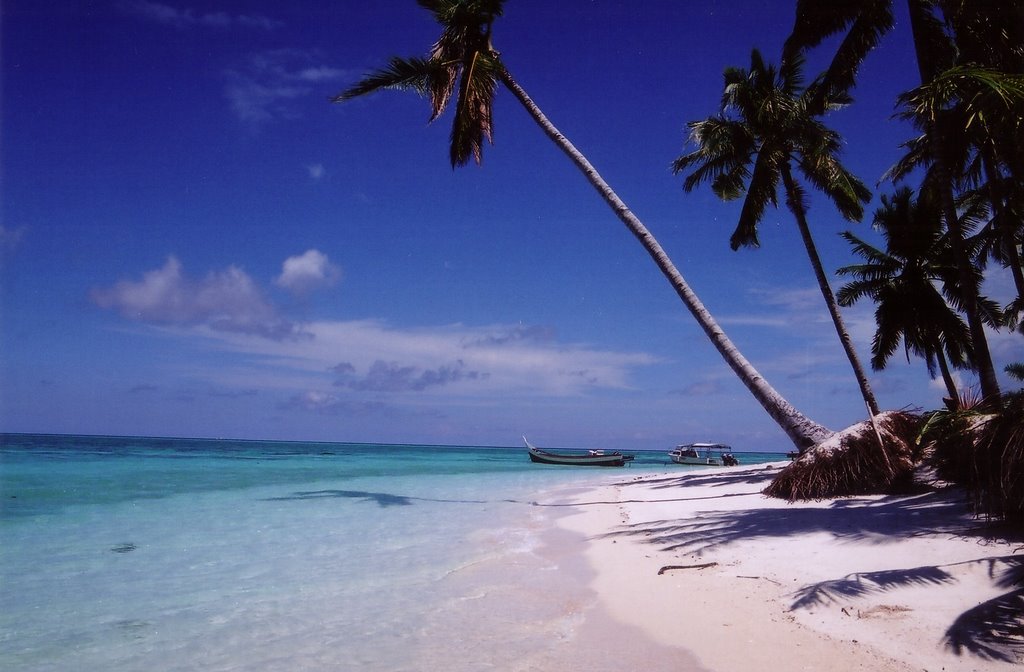 Morning at Mabul
 Sunset at Mabul
If you noticed, I said “memorable” dives in the title. Not “best” dives. These are not necessarily the most enjoyable dives, but they stick out vividly in my memory. You see, in diving, there is no such thing as a bad dive. There are only different dives. Even a “bad” dive can be good, because it’s different and offers a new experience from which to learn and remember. For example, a dive in low visibility would be bad for recreational purposes, but good for training, so that one would be more prepared for similar low visibility conditions in the future. It builds confidence.
There’s a lesson for life and a spiritual parallel there too. That is, things don’t always go well. Sometimes there are screw-ups and bad weather, but in all things there is a positive side. We know that in all things God works for the good of those who love him, who have been called according to his purpose. Like Joseph, things may look bad now, and people may intend it for evil, but God intends it for good in the end.
So here goes the good, the bad and the ugly… in chronological order.
1. My First Ever Open Water Dive
Anemone City, Pulau Redang, August 2001
Straight after getting my temporary cert from my instructor Nic, the bunch of us five students plunged in for our first dive as qualified divers. Nic took us to Anemone City, which is an obscure dive site off Redang. No buoy, no line. Few people know of this site, and Nic had to direct the boatman to the spot, using the position of the islands for navigation. The current was strong, and Nic went down first with a float and line to set the descent line for us newbies. Guess what? It didn’t work, because the current was swift and the moment we dropped in the water we were carried on the surface away from the line. The boat went round to pick us up and turn around upstream to try descending again. Again it didn’t work. Since we were brand new to open water diving, we were not so quick to descend and ended up separated by the current. Jannie and Cindy were together. Daniel and Beng Hui were together. And I was alone. Well, due to Nic’s *ahem* excellent training, we didn’t panic. We each found our way to the bottom and regrouped with Nic. I remember seeing lots and lots of anemones covering the rocks like a giant rug. Towards the end of the dive I ran low on air and had to share with Nic (how embarassing!). We got back on the boat and headed back to shore. I can't remember what happened after that.
2. Night Diving
Pulau Redang, August 2001
My first night dive was actually an “unauthorized” one. According to the PADI syllabus, divers only learn night diving in the Advanced course. But since our instructor was keen to give us a feel of night diving right after our basic Open Water certification, he took us out one night to the shallow reef in front of Redang Bay Resort. You could say it was an unofficial introduction to diving in darkness. We grabbed our underwater torchlights, geared up and walked down to the warm sea water after dinner. To cut a long story short, I don’t remember seeing anything but rocks and boulders. I guess we were more concerned with overcoming our initial fears and sticking close to our instructor, so as not to get lost. You could tell we were really rookie divers, because towards the end of the dive my buddy thoughtfully handed me her secondary regulator (the “octopus”), thinking that I was low on air. Well, we didn’t realize it, but we were floating at the surface already!
I followed up with a proper Advanced course at Perhentian in March 2002. There, the instructor took us out for a proper training night dive. We went through the skills test and simulations. Since then, I’ve done a handful of night dives. Night diving is always exciting and adrenaline-inducing. The only bummer is that I have to get wet and salty again at the end of the day, when I would rather be snug and dry, and enjoying the sunset and dinner. Instead, I have to eat dinner early, or rush through dinner, or eat leftovers later, coz the best time for night diving clashes with dinnertime. I’ll also miss the sunset coz I’ll be busy preparing for the dive. And after the dive, I have to pack and wash the gear, and shower again. If the dive ends late, I’ll have wet hair till late at night (I don’t believe in hairdryers, except in emergencies). Kinda spoils the relaxing mood… but I’ll still go night diving, because you never know what you’ll find. I saw a moray eel once, right in front of Coral View Resort, Perhentian. I think it was a honeycomb moray -- white with black dots -- or perhaps it was a black spotted moray...? :)
3. The Puke Dive
Rayner’s Rock, Pulau Dayang, October 2002
This was one of my “worst” dives. People usually ask, what bodily functions can you do underwater? The answer is, everything. The only problem is, your wetsuit gets in the way. Divers routinely pee in their wetsuits. There’s no other way out. The urge to let go is due to the cold water and immersion diuresis, which is the urge to pee induced by the effect of being submerged. Scientists have documented this fact but the exact cause is still not clear. Anyway, I should be talking about puking, not peeing.
It was a windy day and the waves were rough. I was sleep-deprived from the previous night’s traveling. Rough sea + fatigue = sea sickness. On top of that, I had a heavy lunch which included greasy mee goreng. Ah, recipe for disaster. For the afternoon dive, which was soon after lunch, i.e. no time for the food to digest, we went out to Rayner’s Rock. This is supposed to be one of the best dive sites at Pulau Dayang. But my memory only remembers the puke. About 10 minutes into the dive, my headache began throbbing and my stomach started feeling queasy. Nausea. Vertigo. Lunch was on its way out... and out it came, at 18m underwater. I whipped the regulator out of my mouth, but I was just a bit too late... and so parts of the barf went into the regulator (Yuck!), while the rest went into the watery world! Little bits of lunch started floating away in the current, and hungry fish darted over to gobble it up. Vomit certainly looks different underwater. It spreads out in a thin film, with strings of digestive mucus clinging on. I felt much better after getting it all out. Vomit leaves a bad taste in the mouth, so I gargled and spit with seawater. Ptooeyyy! I put the regulator back in my mouth, but it smelled of vomit! Arrgghhh! So I took it out and flooded it and purged it a number of times until it was clean. I continued the dive feeling much better. Later when I got back to the jetty after the dive I cleaned out the regulator properly… there were still bits of orange sacs and fibre stuck inside. And that ends the story of the puke dive.
4. The Combo Dive
Pulau Tenggol, May 2003
This was the deepest night dive I’ve ever done. It was down to 100 feet (30m), to a fishing boat wreck in the bay where all the resorts on Tenggol are located. But I was on a live-aboard dive trip, so I didn’t touch land for 3 days. Our dive boat was tied to the mooring buoy which was anchored to the wreck. During this dive, I also had to do some navigation at the bottom. So, in a sense, that one dive fulfilled the requirements of the Advanced course: Deep dive, night dive, boat dive, navigation.
It was an eventful dive. Earlier that day, we dived the same wreck to check it out. It’s a rule of night diving, that you should dive in familiar sites, which you have previously dived in the daytime. So, anyway, Andrew, Cheng and I descended with the others. At the bottom, Cheng suddenly made some signals that he wanted to go up. Andrew also followed him up. Later, I found out that Cheng had bad air in his tank, and couldn't stand breathing that air and therefore aborted the dive. I didn’t get the message, so I stayed back, thinking that I could join the other group. In the commotion, the other group had gone ahead and left me behind too! So, there I was, all alone in the dark, 100 feet below the surface… For a moment, I panicked. But then I remembered the procedures taught during training. And as long as my air supply was OK, I should be OK. First step is to look for my other buddies. So I blacked out my light by pointing it onto my wetsuit, and scanned 360 degrees around for other sources of light. After a few seconds of hovering in darkness, I saw the faint beams of the other group’s torchlights in the distance. I quickly made a beeline for the group, and was surprised to find that they were exploring another nearby boat wreck. So, I dived (1) from a boat, (2) to a deep wreck, (3) at night, and (4) navigated from one wreck to another. A combo dive.
5. The Glamour Dive
Sharon's Stone, Pulau Redang, August 2004
I did a dive trip to Redang with my brother. We stayed at Redang Bay Resort, which has probably the cheapest dive rates on the island. Sharon’s Stone sounded alluring enough, and so we geared up and boarded the boat eagerly. Well waddaya know, the visibility that day was bad, just a few metres. Even the divemasters couldn’t get their bearings. It was a comedy of errors. We descended without a line, which would have been OK in clear water, but in low viz we couldn’t see where we were going. Then there was a diver from another group who couldn’t equalize, thus keeping us waiting. A divemaster stayed back to help the fella descend, while the rest of us chased after the other divemaster who had gone ahead of us and was speeding into the distance, oblivious to the delay. I was afraid that we would lose sight of him in the poor visibility. And so, there we were madly chasing the divemaster, who was zooming ahead in search of the Sharon’s Stone reef. Well, he couldn’t find it! We spent the next 20 minutes skimming over the sandy bottom.
Sand, sand, sand everywhere. As a consolation we did manage to see some cute little shrimps on anemone clumps out in the middle of the sandy bottom. I saw some sea pens, starfish and worms too. Diving in poor visibility can be disorientating, especially when you can’t differentiate up from down. When you can’t see the bottom, or any reference point in the distance, your eyes start playing tricks on you. It’s like an autofocus camera trying to focus on a blank sheet of paper. After a while I even started feeling a bit of vertigo. So, we finned close to the bottom, with our noses almost in the sand… well, almost. We ended the dive with a safety stop in open water. Later, the dive shop gave us a discount on the dive, since we didn’t arrive at the intended destination. How nice of them.
6. Sugar Wreck
Pulau Perhentian, August 2004-2006
This has to be one of my favourite dive sites. I’ve dived there on each of my annual trips to Perhentian over the past 3 years. Each time, the diving conditions were different. The first time had no current, good viz. Second time had moderate current, poor viz. Third time had strong current, moderate viz. But I saw the most fish during the third time. The current was so strong that we had to grab the line during the safety stop, and we ended up looking like flags flapping in the wind – a whole line of divers trailing from the line. A bit like a clothesline caught in the wind.
Sugar Wreck is a sunken 90m bulk carrier ship. It was carrying sugar (hence the name) when it sank in December 2000. It now lies in 18m of water, but because it’s a pretty big ship, the top of the wreck is only 6m below the surface. There’s a warning buoy anchored to the wreck.
Sugar Wreck is good for reliving the Titanic experience, especially on the descent, where you glide over the hulking mass of the wreck, avoiding the railings, cranes, masts and ropes that protrude through the water. Most of the wreck’s surfaces are covered with slime, or soft corals, or barnacles. There’s lots of pufferfish near the stern of the wreck. You can also see a school of razorfish that swim vertically, head down-tail up. There’s also lionfish and scorpionfish. A bamboo shark hides under one of the masts. I saw a turtle the first time I dived there, but none ever since. A lone barracuda resides in the hull of the wreck. The divemaster will usually take divers on a tour of the wreck, from one end to the other, and detouring into the open hull of the wreck. The ship rests on its starboard side on the silty seabed, leaving the hull opening sideways. Strictly speaking, this is not technical wreck diving, as there is no penetration of enclosed passages. We always make sure there is a direct access to the surface in case of emergency.
7. Sipadan-Mabul
Pulau Sipadan and Pulau Mabul, May 2005
It’s difficult to pinpoint the most memorable dive at Sipadan-Mabul. Besides the first ever dive at Sipadan, which I mention in No. 8 below, the memory of Sipadan-Mabul just can’t be dissected into individual dives. It’s more like a mosaic than a snapshot. Among the scenes that stick out clearly are the first boat ride from Mabul to Sipadan. You know, it’s like after all the hype about Sipadan, I was finally on my way there, on the speedboat skimming over the deep blue waters of the Celebes Sea. I had my camera to take some landside photos of the island, but unfortunately I had no underwater camera. Someone said they saw dolphins, but of course, I had to be the one who didn't see them...
Some flashbacks of Sipadan-Mabul:
- Snorkelling at the Drop Off during our surface intervals. It’s like no other snorkeling experience I had up till that time. Imagine, swimming over sandy bottom 3m deep… then suddenly the bottom just disappears over the edge, and all you see is a wall dropping almost infinitely into the deep blue below. I ventured out from the sandy bottom, towards the open water and bottomless sea, always keeping a watchful eye on the white sandy bottom nearby and making sure I knew how far away I was! I didn’t want to get into trouble while hovering over nothing but water. See, if I dropped my watch there, it would fall for 600m before hitting bottom. It’s a really awesome feeling of fear mixed with adventure. There’s a lot of hard and soft corals growing on the wall and ledges, and a profusion of fish that patrol the edge between beach and abyss. The resident lone barracuda hides among the legs of the wooden jetty. A turtle swam by. Ladidadidumdum. I didn’t dive at the Drop Off, but snorkeling there was just about good enough!
- Barracuda Point was a terrible disappointment, because there were NO barrucudas. Zero. I dived there four times to no avail. But there were some other interesting sights that partially made up for the total lack of barracudas. I saw lots of reef sharks. Loads of them. There’s a place called The Airport where a whole “squadron” of grey reef sharks would rest on the flat rocky bottom, making it look like an airport with sleek fighter jets parked on the tarmac. At one point, a rare leopard shark sped past in the swift current. I only managed to catch a glimpse of its side and tail, as it quickly disappeared behind us. Divers are incredibly clumsy in water compared to fish (Duh~!). I was being pushed along by the current (doing what we call a “drift dive”), and the shark just went the opposite direction, against the current, effortlessly!
- Turtles, turtles, everywhere. I stopped counting after a while. There’s turtles swimming, turtles eating, turtles sleeping, but I didn’t see turtles mating…
- Lots of fish! At Sipadan, you'll see many types of fish that you can see elsewhere too, but they're in greater number at Sipadan. If you see one batfish at Redang, you'll probably see five at Sipadan. Just multiply the numbers.
- Diving at Mabul is great for seeing little critters and bottom-dwelling creatures. It was my first time seeing frogfish, crocodilefish, ribbon eels and loads of big, colourful nudibranchs. I was diving with some seasoned divers who talked in scientific lingo, like “Oh, did you see that beautiful Chromodoris?” And so I had to quickly brush up on my Latin to counter with phrases like, “Oh yeah, wasn’t that a Phyllidia?” I like a mix of little critters and big fish in diving. Some people are macro lovers, others prefer wide angle. I like both.
- Sunsets at Mabul are lovely... so too is the morning sky, as you can see in the two pictures above.
8. My Virgin Sipadan Dive
South Point, Pulau Sipadan, May 2005
My first time at Sipadan also happens to be my deepest dive ever. We went down to 130 feet (40 metres)!!! The water was so clear that it didn’t feel that deep. I had my first taste of Sipadan’s legendary depths, as I couldn’t see the bottom which was another 600 m below. My only indication of land was the sloping wall on my left. Unfortunately, the marine life was rather sparse. Hardly any fish worth noticing. And at that depth the wall was devoid of corals. Everything was a shade of blue or grey. The most obvious sign of life was the hissing of the dense air coming through the regulator with every breath that I took.
But the idea of logging such a depth on the depth gauge was thrilling enough. OK, maybe it’s a cheap thrill. But it doesn’t happen everyday. I’m still wondering if I actually got nitrogen narcosis on that dive. I don’t recall getting a “high”. That only means one thing, I gotta go back and do it again to find out. :P
9. Big Fish Dive
West Ridge, Pulau Sipadan, May 2005
Imagine the largest shoal of fish you’ve ever seen. Then imagine swimming into it, under it, through it, around it. Yup, I swam right into a massive shoal of trevallies. From a distance the reflective silver scales of the fish made the shoal appear like a fuzzy gray blob on the blue background. The current was carrying us divers along, and soon we were drifted into the living wall. The current was flowing but the shoal was stationary, hovering in the water like a hot air balloon in the sky. I was at the bottom about 12m deep, and I saw the shoal extend from the sea bed almost to the surface. That’s a 12m-high wall of fish. That’s A LOT of fish. Swimming into the shoal of thousands of fish was a truly incredible experience. It’s like being surrounded by an amorphous living blob that shifts, swirls and folds around you as you play with it. I dropped to the bottom and slowly ascended through the middle… slowly the mass of fishes parted and surrounded me, swirling around. The fish wouldn’t let us divers too close to them, but it was a pretty close encounter. I could see the sleek silver fins gleaming in the sunrays that pierced through the water and almost gaze into their eyes, if only they would stop swimming around! The wall of glimmering silver was disorientating at times, when the fish started circling me and making me lose my sense of direction. Exhilarating! I think I spent 10 minutes with the blob of fish before I had to continue with the drift dive and watch the silver slowly fade to gray and nothingness. This is what diving is about! =)
I didn’t get to see the famed school of barracudas at Sipadan, despite diving at Barracuda Point four times! So this school of trevallies is the compensation. Not as majestic as barracudas but better than nothing.
Oh BTW, trevallies are good to eat. Once when I was diving with my instructor on my first few dives, we came across some trevallies. Being the ever-helpful instructor who wanted to educate his students well, he scribbled on his underwater slate “Lunch” with an arrow pointing to the trevallies swimming by. :P
10. My First No Wetsuit Dive
D’Lagoon, Pulau Perhentian, August 2005
Most divers dive with a wetsuit. It’s for protection against the cold, and against scrapes and scratches from corals and rough surfaces, and stings and bites from creatures. But in warm tropical waters, there’s not much need for insulation from cold water, unless it’s a deep dive into colder water, or there happens to be a thermocline or cold currents. For shallow water dives, I’ve come to the conclusion that it’s warm enough to dive without a wetsuit. And in my opinion, there’s no need to protect oneself from the corals. In fact the reverse is true. The corals need protection from divers! That’s why the more environmentally conscious dive operators prohibit divers from wearing gloves, so that they don’t go around grabbing live corals.
Back to the wetsuit… we were going to dive in the warm shallow waters of D’Lagoon a.k.a. Teluk Kerma and I decided to ditch my wetsuit. I figured that since it was afternoon and the dive was shallow, it would be just nice to try plunging in wearing just a pair of shorts and lycra vest. The sense of freedom was very refreshing. Another advantage is that I needed to use only one piece of weight because there’s no need to counter the buoyancy of a wetsuit. My last 4 dives at Perhentian this year were without wetsuit -- just skinsuit top and boardshorts. It also eliminates the hassle of lugging a damp heavy wetsuit back from the trip. And there's no need to rinse the wetsuit. Yay. Well, I know wetsuits are important for protection against the cold and for general protection against exposure to the elements, including the sun when at the surface. But I just like the freedom of no wetsuit on me. Maybe I'll change my mind when I get caught in a cold current one fine day, or run into a horde of jellyfish. :)
D’Lagoon is a very easy dive site. It’s shallow and without currents. We were blessed by the presence of a school of bumphead parrotfish chomping on the corals. There were about a dozen of the metre-long bumpheads. It was great. (I went all the way to Sipadan earlier in May 2005 but didn’t see any bumpheads! Maybe it was the wrong time.) Back to D’Lagoon, I also saw a cute reef cuttlefish that was hovering above a rock on the sandy area. Cuttlefish are nice to play with, as they hang around to check out divers and they have the amazing ability to change colours. On the sand they are white. On the reef they morph to brown or whatever colour the background is. Sometimes half the body is white while the other half is stone coloured. D’Lagoon is also known for the cleaning station where anemone shrimp clean fishes’ mouths and gills. Sort of like brushing teeth. The shrimp will pick off bits and pieces of food or parasites from their clients’ mouths, scales and gills. We divers get the same treatment too, but on our fingers. As we approach the anemones, we just stick out our hands and the shrimp will swarm over and start to pick at our cuticles with their little pincers. It’s a really amusing sight to see the one inch shrimps trying to clean our cuticles. Free “manicure”.
:)
Subscribe to:
Posts (Atom)
